Epernay Champagne Facts: 110 km of Cellars, a 66 m Tower and a Myth
The short answer. About 110 km of cellars run under a single 1.5 km street in Epernay. Moët & Chandon alone has 28 km. A bottle holds 5 to 6 bar of pressure and needs 1.2 kg of grapes. And Dom Pérignon, buried 6 km away, did not invent the drink.
You can walk the Avenue de Champagne in twenty minutes and never guess what lies under it. These are the facts that change how you see Epernay, each from the houses, the Comité Champagne or UNESCO. Read them before you go and you will know what to ask your guide.
The cellars under the avenue
1. About 110 km of cellars run under one street
The Avenue de Champagne is 1.5 km long, and around 110 km of cellars lie beneath it. The houses dug them into the chalk, which holds a steady 10 to 12 °C all year. That cold, still air is what lets a bottle age slowly for years.
2. One house owns 28 km of them
Moët & Chandon, at 18 avenue de Champagne, has 28 km of cellars. Its shortest visit runs an hour and a half and costs EUR 48, with two glasses.
3. At Mercier you tour the cellars by train
Mercier, at no. 68, has 18 km of cellars 30 m down. You see them from a driverless train, included in every ticket from EUR 25. Mercier also has a lift and an entrance for wheelchair users.
4. A tower of 237 steps looks down on the avenue
de Castellane's tower rises 66 m over eight floors, and you climb 237 steps to the top. Its label room holds 7,000 drawers. The building is a listed historic monument, and its tower tour costs EUR 20 with one glass. To see the label room itself, book the heritage tour: EUR 60 for an hour and a half, six people at most, entered from 57 rue de Verdun. Its cellars are closed to the public for now, so the tower and the heritage tour are what you can book.
The monk and the myth
5. Nobody invented champagne
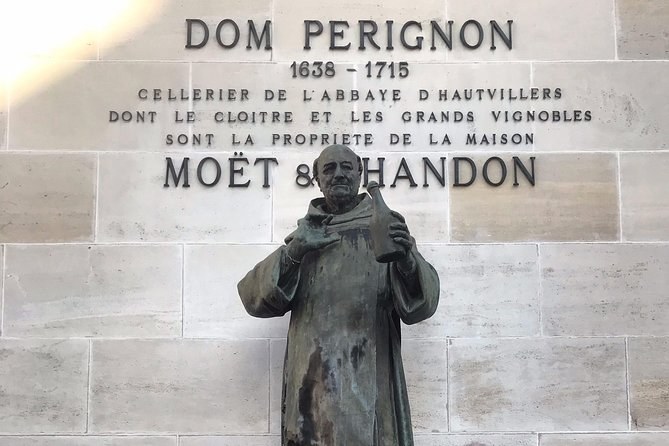
You will hear that Dom Pérignon invented champagne. The Comité Champagne says plainly that nobody did. What Champagne did first was learn to control the second fermentation, the one that makes the bubbles in the bottle.
6. Dom Pérignon was a blender
Dom Pierre Pérignon came to the abbey at Hautvillers in 1668, aged 29, and managed its property for 47 years. He improved the abbey's wines by blending grapes from different plots, which is still how most champagne is made. He died in 1715.
7. You can see his grave, but not his abbey
His tomb lies in the choir of the Saint-Sindulphe church, open all year. The abbey buildings belong to Moët & Chandon, which bought them in 1823, and they are closed to visitors. Things to do in Epernay covers the church and the village for a visit on your own.
What is in the bottle
8. A bottle holds 5 to 6 bar of pressure
That pressure is why a champagne bottle's glass is so thick. It also takes about 1.2 kg of grapes to fill one bottle, so a single vine row fills fewer bottles than you might think.
9. It must wait before it is sold
A non-vintage champagne ages at least 15 months before release. A vintage champagne, from a single year's harvest, waits at least three years.
10. Three grapes share the vineyard
Across 34,200 hectares and 319 villages, Pinot Noir covers 38% of the vines, Chardonnay 32% and Meunier 30%.
11. The label tells you who made it
Two letters on the label say what kind of maker you are drinking:
| Code | Stands for | What it means |
|---|---|---|
| RM | Récoltant-manipulant | A grower who makes champagne only from its own vines |
| NM | Négociant-manipulant | A house that buys grapes as well as growing them |
| RC | Récoltant-coopérateur | A grower selling champagne made by its cooperative |
The people behind the glass
12. Growers outnumber houses forty to one
The Comité Champagne counts 16,460 growers, 120 cooperatives and 410 houses. Yet of the 266.1 million bottles shipped in 2025, the houses sold 191.9 million. The growers and cooperatives sold 74.2 million. So a family grower's glass is the rarer one, and a tour is the easiest way to taste it.
13. The avenue has one cooperative
Esterlin, at 25 avenue de Champagne, is the avenue's only cooperative. It was founded in 1948 in Mancy, south of Epernay. A cooperative presses and makes wine for the growers who belong to it, which is where the RC code on a label comes from. On a tour, a cooperative is the middle ground between a family table and a big house's cellars.
14. Some houses are family businesses too
Boizel, at no. 46, has been run by six generations since 1834. Perrier-Jouët keeps two addresses: its Cellier Belle Epoque at no. 26 and the Maison Belle Epoque at no. 11, which serves lunches and dinners from Tuesday to Saturday.
15. Only 17 villages are Grand Cru
Of the 319 villages in the appellation, 17 are classed Grand Cru and 42 Premier Cru. Ask your guide which ones you pass: several tours sell Grand Cru and Premier Cru tastings.
16. The biggest buyers abroad are American and British
Outside France, the United States and the United Kingdom are champagne's two largest markets.
The calendar
17. The 2026 harvest started in August
Picking opened on 17 August in Epernay and on 15 August in Hautvillers, by the Comité Champagne's own dates. The harvest is usually described as a September event; 2026 came a month early. When to visit Epernay sets the harvest beside the houses' calendars.
18. The avenue lights up in December
Habits de Lumière, the avenue's winter festival, runs on 11, 12 and 13 December 2026, its 26th edition, with video-mapping and shows on the Friday and Saturday evenings. In summer, the Soirée Blanche fills the avenue on 14 July.
For the practical side, how to visit Epernay covers trains and bookings, and the Epernay visitor guide has the station-to-avenue walk. The Epernay champagne houses compares every visit, when to visit sets the calendar, and things to do in Epernay covers the museum and the villages.
Days that put these facts in front of you
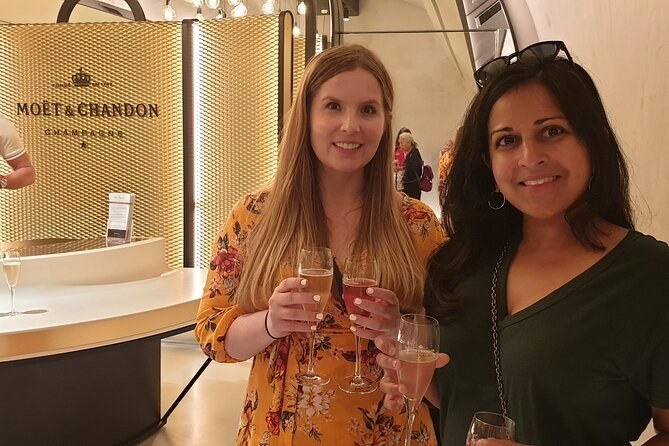
Day tour Tasting at Moët & Chandon and 2 Big Houses in Epernay
Seven hours on foot along the avenue: three big houses with their own guides, seven glasses and a three-course lunch. Non-refundable once booked.
From $632 per person
Check Availability
From Paris: Small-Group Champagne Day Trip with Six Tastings
Eleven hours from a Paris café at 7:00 am: the cathedral in Reims, a family winery and a big house at Chouilly, six glasses. Lunch is yours.
From $263 per person
Check AvailabilityNext: take one fact to the cellar with you, and ask your guide about it. Every fare sits side by side on Epernay Tours.